

Seminar:
Digital engineering
for the plastic industry
18 November 2025
| Technical University of Denmark Anker Engelunds Vej 1 Building 101, Meeting Center, room S01 2800 Lyngby |
Registration deadline 13 November
About the seminar
Are you driving innovation in polymer product development or process optimization? Join us for the Digital Engineering for the Plastic Industry seminar — a full-day event packed with cutting-edge insights from industry leaders like LEGO, Novo Nordisk, Covestro, Coloplast, Husky Technologies™, TetraPak, and DTU, focused on the latest advancements in simulation technology for the plastics industry.
Discover how virtual prototyping, AI, machine learning, and advanced simulation technologies are transforming injection molding, crash testing, warpage prediction, and packaging development. Whether you are optimizing hot runner systems or building digital twins for zero-defect manufacturing, this seminar offers actionable strategies and real-world case studies to elevate your R&D capabilities.
Organizers
This seminar is organized by Guido Tosello, Kristian Melgaard Jørgensen, Frank Rasmussen and Carsten Lund from Teknologisk Videndeling’s steering group for plastic technology.
Programme
|
Registration and breakfast | |||
|
Welcome and introduction | |||

|
Reactive vs Proactive warpage simulation and the development of the CAE “Quick Warpage” order type at The LEGO Group Julian Charity, CAE Manager, The LEGO Group 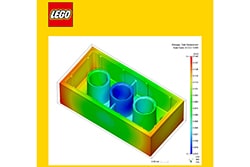 CAE moulding simulations are often used in a reactive manner when there is already a warpage problem on a moulded part. However, screening for and predicting warpage tendencies up front via simulation can help resolve many moulding issues before a mould is even made. This presentation looks at the automation journey CAE at The LEGO Group have been on and how we developed and automated a new “Quick Warpage” simulation type. Julian Charity studied Industrial Design and Technology at Brunel University in London. After graduating, he began his career in the automotive industry, where he developed a strong interest in injection moulding and CAE simulation.This passion for plastics led him to The LEGO Group in Denmark, where he has worked for the past 15 years as a specialist in CAE. |
|||

|
Moulded components 15-40% closer to nominal dimensions by mastering differential shrinkage Rasmus Storgård Knudsen, DFM-Moulding Specialist, Novo Nordisk A/S 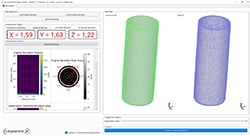 When molten plastics solidify, materials can experience up to 30% volumetric shrinkage. Traditionally, injection moulding tools compensate for this shrinkage using a single global shrinkage factor, -despite the well-known anisotropic behavior of shrinkage. In this presentation, we share the journey that allows us to better account for differential shrinkage and achieve moulded components closer to nominal dimensions. Initially, we struggled to predict shrinkage accurately in Moldflow simulations and relied on experimental correction factors and local cross-section shrinkage investigations. Over time, this evolved into today’s automated Design for Manufacturing (DFM) tool. The shrinkage tool delivers optimal shrinkage values (x, y, z) within minutes, works by comparing simulations or moulded components to nominal dimensions, while decoupling warpage from the equation to avoid inaccuracies. Rasmus Knudsen is a Plastic Process Technician, BSc Mechanical Engineering, with 20 years of experience in the plastic industry, and a consistent record of ensuring robustness and scalability of devices for high volume production. Passionate about virtual development and a keen interest in teaching colleagues within the world of injection moulding, simulations and good DFM practices. |
|||
|
Coffee and networking break | |||

|
Injection Molding Optimization with AI-Driven Process Simulation Guido Tosello, Associate Professor, DTU Construct 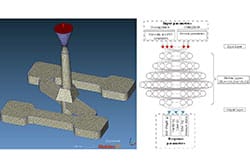 Data-driven modeling and deep learning are revolutionizing industrial operations many sectors, and injection molding is no exception. This presentation introduces a data-driven framework integrating Finite Element Analysis (FEA), Design of Experiments (DOE), and Deep Neural Networks (DNNs) to model and optimize injection molding of thermoplastics. The developed algorithm correlates melt temperature, mold temperature, and injection speed with key outputs—part weight, cavity injection time, and injection pressure for several polymer grades. Material-specific viscosity and pressure-specific volume-Temperature model coefficients are embedded into predictive models, achieving accuracy across unseen materials beyond the training dataset. The approach demonstrates superior performance over traditional regression methods, enabling robust digital twins for process optimization and defect minimization in precision polymer manufacturing. Whether you’re working with ABS, PEEK, or PLA, this session offers actionable insights for engineers aiming to elevate precision and efficiency in polymer processing. Guido Tosello has 15+ years of research experience in the analysis, characterization, monitoring, control, optimization of plastics processing technologies of thermoplastic materials from conventional size down to micro and nano scales, including simulation, tooling and metrology.He is currently Associate Professor at the Section of Manufacturing Engineering, Department of Civil and Mechanical Engineering, Technical University of Denmark, Head of Studies of the Master of Science program ‘Materials and Manufacturing Engineering’, and Coordinator of the Horizon2020 European project DIGIMAN4.0 ‘Digital Manufacturing Technologies for Zero-defect Industry 4.0 Production’ (2019-2024). |
|||

|
From prototyping to virtual testing in product development Kim Lau Nielsen, Senior Principal Simulation Engineer, Coloplast Using simulations for virtual testing in product development offers a great opportunity with respect to building early insight and knowledge by enabling rapid design evaluations. However, the adoption of virtual testing comes with new challenges: from culture changes to data collection, storage, and analysis. The presentation will showcase examples on how simulation helps increasing the innovation height in Coloplast, while at the same time trouble shooting when the simulations do match reality. Afventer mini cv samt billede |
|||
|
Lunch and networking break | |||

|
How to enhance viscosity measurements using digital tools and machine learning for simulation of injection molding processes. (online presentation) Felix Baudach, Global Digital Engineering, Covestro The presentation introduces an innovative material characterization workflow that overcomes traditional limitations in rheological measurements for injection molding simulations. By combining laboratory experiments with advanced computational fluid dynamics (CFD) and machine learning technique, we achieve improved viscosity predictions across diverse processing conditions. Our approach eliminates common measurement inaccuracies and reduces the need for extensive experimental trials, delivering more reliable simulation inputs. 2012, Master of Science, Mechanical Engineering, University of Rostock. Since 2015, Simulation Engineer, R&D – Application Development, Covestro |
|||

|
Husky – how Rheologic, Structural and Thermal simulation is used in development and optimization of hot runners and molds Sheldon Alexander, Hot Runners and Controllers Business Manager, Husky Technologies™ 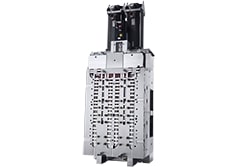 System balance plays an important role in the optimization of an injection molding process and can be the limiting factor in the production of high-quality parts from every cavity. In this presentation, Husky will present the process fundamentals of system and hot runner balance and its impact on mold qualification. By utilizing rheologic, structural and thermal simulation and analysis, we will look at the factors that enable well-designed, balanced hot runners and the causes of unbalanced systems. Attendees will learn about key areas of hot runner analysis, the factors that influence short shot balance, how to measure system balance and how to set system balance expectations based on specific applications. Key Takeaways:
|
|||
|
Coffee and networking break | |||
|
Improving mechanical performance of polymer valve assisted by simulations (joined talk: Lars & Edwin) Lars Nickelsen, M.SC. Virtual Processing, Danfoss 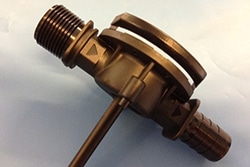 A Metal Replacement into a Polymer Valve started as an unsuccessful design, not reaching our approval demands. It was therefore decided to stop the project. A negative outcome but based on the learnings and the possibility of teaming up with material supplier and moulder/tool designer in a closer cooperation it was decided to restart the project as generation 2 polymer valve a few years later. Based on a combination of structural and injection moulding simulations the design was successful improved, and the polymer valve was released. Lars Nickelsen (Master of Science in mechanical engineering) is Material Specialist focusing on Polymers at Danfoss. Lars has 30 years of experience working with virtual processing as a part of R&D specializing in metal replacement in hot water applications. |
|||

|
Edwin Groothuis, Key Account Management, Erteco Edwin Groothuis is Key Account Management at Erteco Rubber & Plastics. Edwin is an Export Manager and has 27 years of experience with business development, distribution and branding of a broad range and polymers for Erteco. |
|||

|
Using CAE for Accelerated Development of Plastic Packaging Renan Melhado Mazza, Early Innovation Driver, TetraPak 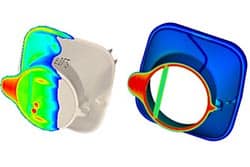 The use of Computer-Aided Engineering (CAE) tools in the development of plastic parts plays a crucial role in reducing time to market and minimizing trial-and-error iterations. However, applying simulation effectively across different development phases requires careful consideration to avoid common pitfalls. In this presentation, we will explore how simulation can be integrated throughout the design process, highlight best practices, and share examples from the packaging industry. Renan Melhado Mazza is an Early Innovation Activity Driver at Tetra Pak, with over 15 years of experience in simulation and injection molding. He is an expert certified user of Autodesk Moldflow, specializing in the development of plastic components. |
|||
|
Closing remark |
Registration fee
| DKK 2,845 | Members of Teknologisk Videndeling and promoting partners listed in the registration form |
| DKK 3,395 | Non-members |
| DKK 1,125 | PhD Students |
| DKK 200 | BSc and MSc students (Membership is free of charge – register here.) |
All prices are excluded of Danish VAT 25 %.
The fee includes talks, breakfast, lunch and coffee breaks and access to speakers’ presentations.
Early bird discount of DKK 300,- when registering before 17 October 2025. Early-bird discount does not apply to BSc, MSc and PhD students.
Registration
Binding registration
Registration is binding, however, substitutions are accepted at any time.
In case of questions please contact us at teknologiskvidendeling@construct.dtu.dk or at +45 2724 2782/ +45 9351 1276
Promoting partners


