

Online seminar:
Scaling Circular Materials
– Technologies and Opportunities for Material Sourcing, Smart Sorting
and High‑Value Reuse and Recycling
|
26 October 2026 |
About the seminar
This online seminar explores innovative pathways toward a circular economy, highlighting advances in bio‑based materials, waste‑system transformation and high‑precision sorting technologies.
Participants will gain insights into how agricultural residues, municipal waste streams and textile materials can be reintegrated into productive cycles.
The seminar emphasizes material transformation and data‑driven and sensor‑based approaches that enhance material purity and enable efficient reuse and recycling. By connecting developments in research, automation and system design the event showcases practical solutions for closing resource loops. Together, the contributions illustrate how technological innovation can accelerate the transition to truly circular material flows.
Target audience
Industry professionals involved in material sourcing, production, waste management and advanced sorting or recycling technologies. The seminar is tailored for managers, engineers and innovation leaders seeking scalable, technology‑driven circular‑economy solutions.
Seminar organizer
Giuliano Bissacco (DTU Construct) from Teknologisk Videndeling’s production steering group.
Registration deadline – No later that Thursday 22 October 2026.
|
Welcome and introduction | |||

|
Agricultural waste as a fiber source for structural and packaging applications reaching a 1-year circularity loop Giuliano Bissacco, Associate Professor, DTU Construct  There is a growing urgency for high‑performance bio‑based packaging solutions in the food and beverage industry. Current solutions, based on biopolymers or natural fibers pose challenges with respect to material sourcing, logistics, performance and largely neglect of end-of-life scenarios. Agricultural waste fibers are a vast untapped local source of cellulose fibers with 1 year circularity loop with high potential for application within the packaging industry. |
|||

|
Circularity Under Constraints: How Bornholm Turns Waste Systems into Testbeds for Real Solutions David Andreas Mana-Ay Christensen, Project Team Lead, BOFA 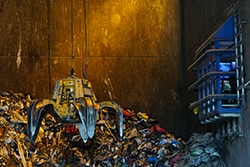 Bornholm is working towards becoming a zero-waste society by 2032. However, as an island, traditional economies of scale for recycling, sorting, and material processing rarely apply. |
|||

|
AI-Driven Textile Sorting: Enabling Recycling and Reuse through Sensor-Based Automation Andreas Lehmann Enevoldsen, Process Development Engineer, NewRetex A/S 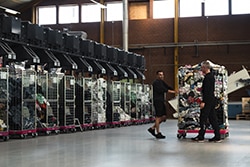 Come inside NewRetex’s work with automated textile sorting technologies and its role in enabling circularity. Learn how sensors—such as near-infrared, X-ray and imaging systems—work together with AI to classify and sort textile waste at industrial scale. You will see how continuous data collection and machine learning improves performance over time, making sorting both smarter and more adaptable. |
|||
|
Break | |||

|
From Textile Waste to High-Value Airlaid Materials Annika Tidemann Jensen, Sales Engineer & Airlaid Specialist, Campen Machinery. 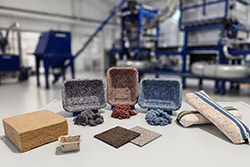 The transition to a circular economy requires scalable technologies that convert post-industrial and post-consumer textile waste into valuable new materials. This presentation demonstrates how existing CAMPEN Airlaid technology can process recycled textile fibres, and other waste streams into functional nonwoven materials with minimal process adaptations. Following the complete material journey – from waste preparation and fibre opening to airlaid formation and downstream bonding technologies – the presentation shares practical experiences with a range of textile waste streams. It highlights the flexibility of the process, discusses key production challenges, and shows examples of high-value end products that support more circular use of fibre resources. Annika holds a degree in Global Business Engineering with a specialization in Mechanical Engineering. She works as a Technical Sales Engineer and Airlaid Specialist in the Airlaid division at CAMPEN Machinery. |
|||

|
Advanced Sensor Based Sorting for Circular Material Streams: Capabilities, Challenges and Insights Vera Pürling, Trainee – Business Development, Tomra Recycling 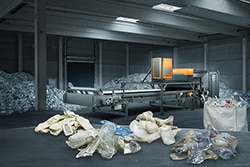 This talk provides an overview of TOMRA Sorting’s advanced sensor‑based technologies and their role in enabling high‑quality recycling across diverse material streams. Participants will gain insights into the sorting capabilities for plastics, mixed waste, and metals, along with challenges that can affect sorting performance and how some of these can be addressed through AI‑supported approaches. |
|||
|
Panel discussion | |||
|
Closing remarks |
Registration fee
| DKK 595 | Members of Teknologisk Videndeling and promoting partners listed in the registration form |
| DKK 895 | Non-members |
| DKK 150 | BSc and MSc students (Membership is free of charge – register here. Early bird discount does not apply) |
| DKK 295 | PhD Students (Early bird discount does not apply) |
All prices are excluded of Danish VAT 25%.
The fee includes talks and after the seminar access to speakers’ presentations.
Invoice will be forwarded 7 days before the event. It is possible to pay by credit card.
Cancellation of event
Should we have to cancel the event you will be notified approximately 7 days before the scheduled activity.
Binding registration
Registration is binding, however substitutions are accepted at any time. Just remember to send us an e-mail so we know who to expect.
Contact information
Please do not hesitate to contact Teknologisk Videndeling by e-mail teknologiskvidendeling@construct.dtu.dk


